You know the look you want: a truck that sits lower, rides with confidence, and has the stance you pictured. The hard part is knowing where to start. With so many truck lowering kits, drop numbers, shock options, and fitment details, it can be easy to buy the wrong setup.
This guide answers the questions you may have before you buy. You will learn how lowering works, what different kit parts do, how to compare drop kits for trucks, and what to expect from trucks lowered for daily driving, weekend cruising, or show use.
You will also get a clear look at the cost of lowering a truck, including parts, labor, shocks, alignment, and other items buyers may miss. By the end, you will know how to choose the right truck lowering suspension for your year, make, model, drivetrain, and driving goals.
DJM Suspension has helped truck owners get the right stance for more than 50 years. As a family-owned, American-made manufacturer, we build truck lowering kits for drivers who want proven fittings, real support, and parts made by people who know lowered trucks.
What Does Lowering a Truck Actually Do?
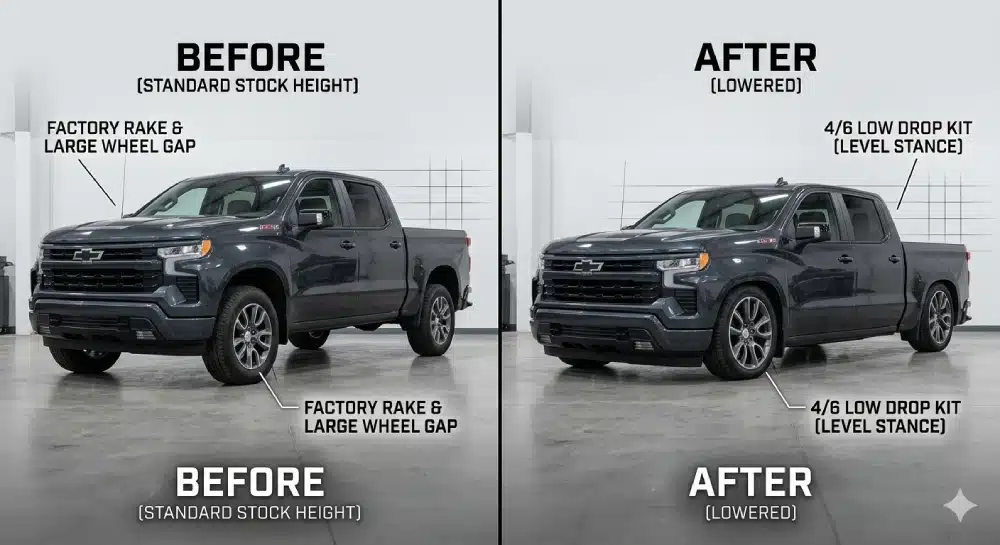
Lowering a truck changes ride height by bringing the body closer to the ground with revised suspension parts or new mounting points. It changes more than looks. It affects weight transfer in turns, braking response, and how suspension arms move through their travel range.
How Suspension Geometry Changes When Ride Height Drops
Every suspension system has a target ride height. Control arms, ball joints, tie rods, shocks, and springs work best within that range. When your truck sits lower, those parts sit at new angles. The change can improve road feel, but the wrong parts can cause bump steer, poor camber gain, limited travel, or early wear.
That is why you need a proper parts list. A mild drop may work well with spindles and shocks for lowered trucks, while a larger drop may need control arms, a flip kit, revised shock lengths, and careful wheel fitment.
Performance Benefits: Handling, Stability, And Fuel Economy
A lower center of gravity reduces body roll. That usually makes your truck feel more planted in turns and more stable during lane changes. Many owners also notice better brake dive control, especially when the setup includes matched shocks and springs.
Aerodynamics can improve, too. A truck with less air moving under the body may see a small gain in highway efficiency. The change is usually modest, not dramatic. Your actual fuel savings depend on tire choice, wheel weight, alignment, and driving habits as much as ride height.
Aesthetic Benefits: Stance, Wheel Fitment, And Custom Look
For many owners, stance is the first reason to lower a truck. A proper drop reduces factory rake, tightens wheel gap, and makes wheel diameter and offset look more intentional. Even a mild setup from quality truck lowering kits can change the truck’s proportions in a major way.
Lowering can also improve wheel fitting. Wheels can sit better in the fenders once the truck loses some stock height. That said, lower does not always mean better. Extreme trucks lowered with poor offset or oversized tires can rub, ride rough, and only work well on smooth pavement.
Trade-Offs: Ground Clearance, Towing Limits, And Alignment Needs
The trade-offs are real. When trucks are lowered, ground clearance drops. That might make maneuvering steep driveways, speed bumps, trailer ramps, and uneven job sites challenging. Approach angle and breakover angle also change, especially on long-wheelbase trucks.
Towing and payload can also change. A lowered truck can still tow in many cases, but some setups reduce rear suspension travel. Tongue weight can make the rear sit even lower, which can lead to bottoming if you do not choose the setup with towing in mind.
Alignment is part of the job after installing a drop kit for your truck. Any ride height change alters camber, caster, and toe. Skipping this step can ruin tires quickly and make your truck feel unstable.
Drop Numbers: What "2/4" and "4/6" Actually Mean
Drop numbers confuse many first-time buyers, but the idea is simple. Once you know what each number means, you can compare truck lowering kits across brands and truck platforms with more confidence.
Front Drop And Rear Drop Explained
A “2/4” drop means your truck sits 2 inches lower in the front and 4 inches lower in the rear. A “4/6” drop, like this 1999-2006 Chevy/GMC Silverado lowering kit, means 4 inches lower in the front and 6 inches lower in the rear. The first number always means front drop. The second number always means rear drop.
| Drop Notation | Front Drop | Rear Drop | Typical Use |
|---|---|---|---|
| 2/2 | 2 inches | 2 inches | Mild stance correction |
| 2/4 | 2 inches | 4 inches | Common street setup |
| 3/5 | 3 inches | 5 inches | Aggressive daily driver |
| 4/6 | 4 inches | 6 inches | Strong street and show look |
| 5/7 | 5 inches | 7 inches | Show-focused build |
Why Front And Rear Drops Are Usually Different
Many trucks leave the factory with a rear rake. That means the rear sits higher than the front at the wheel opening. Manufacturers build this in for payload and towing. A level stance usually needs more rear drop because the rear starts higher.
That is why you see so many 2/4 and 4/6 drop kits for trucks. When you lower your truck, the goal is not always to drop both ends the same amount. It is to get the stance you want after the factory rake is gone.
Common Drop Configurations And When Each Makes Sense
Typically, a 2/2 setup works well if you want a mild drop with fewer clearance issues. It usually keeps a near-stock feel and is perfect for daily use.
The 2/4 truck lowering kits are one of the most popular street combinations. It removes factory rake and gives your truck a clean stance without going too far.
If you want a more aggressive stance, go with a 3/5 or 4/6 setup, like this drop kit for trucks. These drops can still work on the street, but you need to pay closer attention to shocks, control arm angles, wheel width, and tire height.
A 5/7 setup fits more of a show build. It can look great, but it leaves less room for error. Tire fitment, road quality, and frame clearance become bigger concerns.
How Drop Size Affects Ride Quality, Tire Fitment, And Driveability
As drop size increases, suspension travel usually decreases unless the system is built to keep enough travel. Less travel can mean a firmer ride, more reaction to rough pavement, and a greater chance of bottoming.
Tire fitting gets tighter, too. A tire size that works at stock height may rub after lowering, especially during turns or suspension compression. Common rub points include the front inner fender, the rear of the front wheel opening, and the top of the rear fender under load.
Driveability depends on the full truck lowering suspension setup. That means a well-planned 4/6 can drive better than a poorly planned 2/4. The drop number alone does not tell the full story. You need to consider shock valving, spring rate, bump stops, wheel offset, and alignment as well.
Daily Driver Vs. Show Build: How To Pick The Right Drop
If you are a daily driver, start with your roads, parking spots, driveway angle, and tire setup. Typically, a mild to moderate drop makes the most sense if your truck handles commuting, hauling, and mixed road surfaces.
For a show build, stance may matter more than comfort or utility. A larger drop may be the right call, but you need to accept less clearance, less flexibility, and tighter fitting limits. The best way to choose is to rank function first, then stance, your budget, and parts list.
The 6 Types of Truck Lowering Kit Components (And What Each One Does)
A truck lowering kit is a set of parts that each handles a specific job. When you know what each part does, you can shop for kits with fewer mistakes and less wasted money.
Drop Spindles
Drop spindles lower the front of many trucks without changing the spring. They move the wheel mounting point higher on the spindle, which lowers the truck while keeping close to the stock spring rate. That makes them popular for daily drivers.
This design can keep ride quality better than some spring-only drops. It also avoids some harshness that comes from cutting travel too much. Still, spindle design needs to match your wheel diameter, brake setup, and ball joint geometry. Check clearance before you buy.
Lowering Springs
Lowering springs replace factory coils with shorter springs or springs with a revised rate. They give you a direct way to lower the truck, and they can tune both ride height and handling feel.
Spring rate is as important as the drop amount. If a spring is too soft, it can bottom out. If it is too stiff, it can make your truck ride rough on normal roads. Spring drops also reduce compression travel, so shock length and bump stop setup matter.
Lower Control Arms
On many trucks, lower control arms help restore geometry, improve alignment range, and keep safer operating angles at a lower ride height. They matter even more when the drop moves beyond about 3 inches on many IFS (Independent Front Suspension) trucks.
This is where some first-time buyers try to save money and regret it later. Your truck may sit lower without revised control arms. However, tire wear, poor alignment, or odd steering can lead to more frequent repairs if geometry moves too far out of range.
Flip Kits And Lowering Blocks
Flip kits are a common way to lower the rear of a leaf-spring truck. They move the rear axle from below the leaf spring to above it. That creates a large rear drop and explains why 4-, 5-, and 6-inch rear drops are common.
Lowering blocks also lower the rear, but they do it by spacing the axle away from the leaf spring. They usually work for smaller rear drops or final height adjustments. Blocks can work well with the right size and hardware, but axle wrap and shock length still matter.
Shocks For Lowered Trucks
Factory shocks are built for factory ride height and factory travel. Lower a truck without changing shocks, and the shock may top out or bottom out during normal driving. That creates poor ride quality and can shorten shock life fast.
Shocks designed for lowered trucks are valved and sized for the new ride height. They help control bounce, body motion, and stability. In many builds, shocks are one of the most important parts in the full truck lowering suspension, yet many owners skip them.
Coilovers
Coilovers combine a shock and spring into one adjustable assembly. On the right truck, they give you ride height tuning, damping control on some systems, and a clean way to fine-tune stance and handling.
They often fit aggressive builds, handling-focused trucks, or projects that need exact corner-to-corner height control. They also cost more and need a clearer plan before you buy. For some owners, they make sense. For others, they add cost and adjustability that may go unused.
Complete Kits vs. Building Your Own: Which Is Right for You?
While a complete truck lowering kit gives you one path, an à la carte build gives another. Neither is right for every truck, but each fits a different type of project.
What A Complete Lowering Kit Usually Includes
A complete lowering kit, such as this 2002-2005 Dodge Ram 1500 3/ Lowering Kit, usually includes the main parts needed for a stated drop. That may include front spindles, springs, control arms, rear blocks or a rear flip kit, U-bolts, and hardware. The exact parts depend on the truck and drop height.
However, do think about what is not included in the kit. You may need to buy wheels, tires, alignment, labor, and sometimes shocks for lowered trucks separately. Bump stops, brake line changes, or small fitting parts may also vary by application. Check the full parts list before you buy.
Risks Of Mixing Parts From Different Brands
Mixing parts from different brands can work, but it adds risk. One spring may assume stock control arms, while a spindle may change track width slightly. Sometimes, the shock can be too short for the final setup. Each part may be fine, but the full system might still fight itself.
That mismatch can cause poor ride quality, limited alignment range, odd steering feel, or unclear warranty coverage. If a problem shows up, each supplier may point to another part. That can leave you or your installer sorting out the truck's lowering suspension alone.
Why Matched Systems Often Perform Better
Matched systems are built around one target ride height and one geometry range. The spring, spindle, control arm, and shock are made to work together. That usually means fewer installation surprises and a more predictable ride and handling. It is a perfect solution if you are buying truck lowering kits for the first time.
When Building À La Carte Makes Sense
Building à la carte makes sense when the truck is unusual, your build goal is specific, or your budget will be spread across phases. It also works when an experienced installer already knows which drop kits you need for your truck.
For example, you may start with a mild drop, add wheels, revise shocks, and then move to a larger rear drop later. This phased strategy can work. It just takes more planning and more technical confidence.
How to Choose the Right Kit for Your Specific Truck
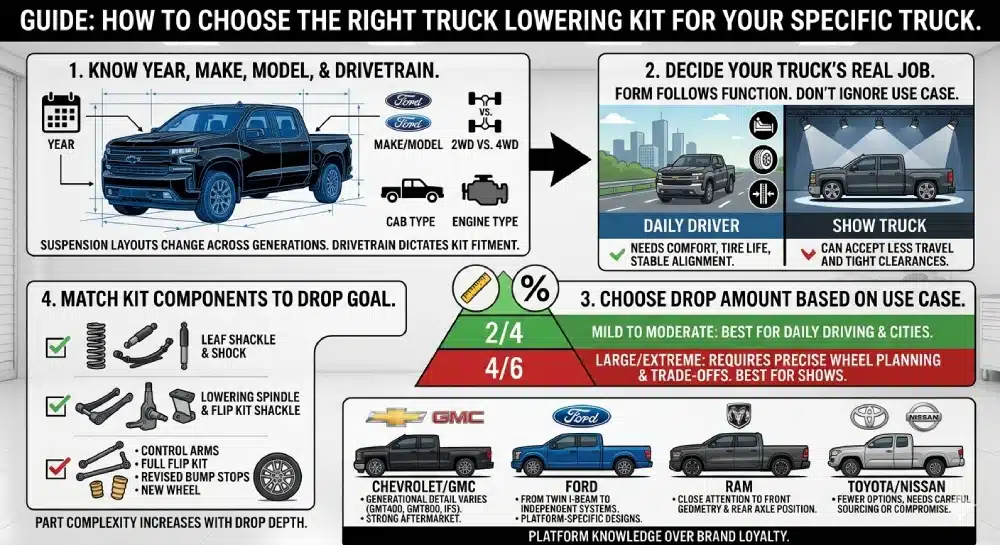
Your lowering plan should start with what fits and what doesn't, not style photos. The right kit depends on your truck first, then how you use it, and then the drop you want.
Step 1: Know The Year, Make, Model, And Drivetrain
Truck suspension design changes across generations, even when the model name stays the same. A 2004 Chevrolet Silverado does not use the same suspension layout as a 2019 Chevrolet Silverado.
You also need to think about two-wheel and four-wheel drive. Many truck lowering kits fit only two-wheel drive trucks, or they vary sharply by drivetrain.
Cab style, engine weight, and trim package are also equally important. Some trucks have factory options that change spring rates, brake size, or ride height. Those details affect how a part will fit.
Step 2: Decide Your Truck’s Real Job
Your truck’s real job should be at the heart of this upgrade. For instance, a daily driver needs comfort, longer tire life, and stable alignment. On the other hand, a show truck may accept less travel and tighter clearances.
Deciding your truck's real job is the biggest filter in the process. Many bad truck lowering suspension choices happen when looks come first, and real use gets ignored.
Step 3: Choose The Drop Amount Based On Use Case
For most daily drivers, mild to moderate drops make the best starting point. They improve stance and handling without pushing every other system too far. You can get a larger drop kit for your trucks, but it needs tighter wheel and tire planning and more clearance trade-offs.
If you live in the city, a lower but usable stance usually beats the lowest possible stance. However, for a show-build and limited road time, you can choose a lower setup.
Step 4: Match Kit Components To The Drop Goal
Once you choose the drop target, match the parts to that goal. A small drop may need springs and shocks, while a mid-level drop may need spindles, rear hardware, and shocks. You may need to add control arms, a flip kit, revised bump stops, and tighter wheel planning for a larger drop.
Don't Forget about Make-Specific Callouts
Chevrolet and GMC trucks are some of the most common trucks lowered in the US. The aftermarket is strong, but setup details change by generation. GMT400, GMT800, and newer IFS trucks each need different parts and have different fitment limits.
Ford trucks range from classic Twin I-Beam setups to modern independent systems. Lowering a classic Ford F100 is different from lowering a late-model F-150. Suspension design sets the path.
Dodge and Ram trucks need close attention to front geometry and rear axle position, especially on larger drops. Toyota and Nissan trucks may have fewer options, and some applications need more careful sourcing or more compromise on the drop amount.
In every case, platform knowledge matters more than brand loyalty. DJM Suspension lets you shop for truck lowering kits based on the make and model. That makes it easier to shop for the right kit, especially for first-time buyers.
How Much Does It Cost to Lower a Truck? (Full Breakdown)
The cost of lowering a truck goes beyond just the kit price. The entire project includes parts, labor, alignment, and the small extras that first-time buyers often overlook.
Kit Costs: Entry-Level, Mid-Range, And Performance
- An entry-level lowering setup starts around $300 to $600. This often covers simpler rear components, basic springs, or a mild drop for a common truck platform.
- Mid-range drop kits for trucks typically fall between $600 and $1,000. They may include better front components, a more complete rear package, and hardware for a more balanced result.
- A performance-oriented or more complete system usually costs between $1,000 and $1,500, sometimes more. It can include matched shocks for lowered trucks, control arms, spindles, or adjustable components.
Labor Costs At A Shop
Professional installation typically costs between $1000 and $2,000+, depending on your truck, region, and how complex the parts are. A mild spring and block install will be on the lower end, while a spindle, control arm, and flip kit install will cost more.
Labor rates vary across the country, with major metro areas often charging more. Classic trucks can also cost more if seized hardware, worn bushings, or old fasteners slow down the job.
Hidden Costs Many Owners Forget
Several costs are easy to miss. Buying new shocks for lowered trucks is a big one, along with alignment. A proper alignment can add $100 to $200 or more, depending on the shop and whether extra adjustments are needed.
New tires may be necessary if your current size rubs after lowering. Wheel spacers may also come into play, though they should only be used for clearance or fitment issues.
Other items like bump stops, replacement bushings, and new U-bolts can add to the cost. If your truck has worn front-end parts, ball joints, or tie rods may need replacing before alignment can be done properly.
DIY Vs. Professional Install
Typically, DIY installation can save you a lot on labor. If you have the right tools, lifting equipment, and suspension experience, it can be the best route. You can finish a basic setup over a weekend.
Professional installation is a better option for trucks with complex front suspension, rusted hardware, or a large drop with several geometry parts. Since suspension work impacts steering, braking, and tire wear, a mistake can cost you dearly in the long run.
Total Budget Ranges By Build Type
A mild daily driver drop may cost between $900 and $1,600, including parts, labor, and alignment. The cost of a moderate setup may run from $1,500 to $2,500, while more aggressive upgrades can push past $3,000.
What to Expect After the Drop: Alignment, Tires & Ride Quality
Installation is not the end of your project. Your truck still needs setup, inspection, and a brief adjustment period.
Why Alignment Is Non-Negotiable
Any change in ride height affects suspension angles, altering toe, camber, and sometimes caster. Even a small misalignment can wear tires quickly, especially toe error. After installation and any noticeable settling period, a proper alignment is a must to prevent issues like uneven tire wear, pulling, or a crooked steering wheel.
Tire Clearance And Rubbing: What To Check
Check tire clearance at full lock, full compression, and under load, while entering driveways, hitting dips, and carrying weight. Clearance depends on tire diameter, width, wheel width, offset, and ride height. Many rubbing issues come from poor wheel and tire choices, not just the lowering components. Make sure your setup has the right fitment to avoid problems.
Ride Quality Changes: What Is Normal And What Is Not
A lowered truck generally feels firmer, which is normal. You’ll notice less body roll and quicker steering. Small bumps may be felt more, especially with low-profile tires. However, if the truck bottoms out, bangs repeatedly, wanders, or has persistent bounce, it’s likely due to mismatched shocks, spring rate, or alignment—issues that need to be addressed for a smooth ride.
Break-In Period For New Components
New springs, bushings, and shocks may settle slightly after installation. This break-in period is usually short, but it can slightly affect ride height. Follow the installation instructions for rechecking hardware after the first several hundred miles to prevent premature wear. Some bushings may also need final torque adjustments at ride height.
Ongoing Maintenance Checks
Lowered trucks need regular inspections, especially in the first year. Check for shock leaks, U-bolt torque, tire wear, bushing condition, bump stop contact, and brake line routing. Also, pay close attention to front-end steering components, as ride height changes how they handle load. For daily drivers, a quick check at each oil change can catch issues early.
Classic Trucks vs. Modern Trucks: Does the Process Differ?
Yes, the process differs quite a bit. While both classic and modern trucks can be lowered, the approach for each is different.
Key Differences In Suspension Design
Classic trucks often have simpler front suspensions and leaf-spring rear layouts with fewer electronics. This makes some changes easier, but it can also mean more wear, old hardware, and reduced tolerances after years of use.
Modern trucks, on the other hand, often feature independent front suspensions, electronic stability systems, and advanced steering geometry. These systems improve factory performance but make lowering more sensitive to part design and alignment precision.
Classic Truck Lowering: C10 And F100 Examples
Classic Chevrolet C10 and Ford F100 trucks are popular for lowering due to their strong aftermarket support and dramatic visual impact. Common parts include lowered coils, drop spindles, rear shackles, hangers, flip kits, and revised shocks.
For very low rear ride heights, some builds may need C-notch work for full suspension travel. However, older trucks often bring additional restoration challenges like worn bushings, sagged springs, and rusted bolts, which may turn a simple lowering project into a suspension rebuild.
Independent Front Suspension And Electronics
Modern trucks require more attention to front suspension geometry. Independent front suspension can lower well, but only if parts are designed for the lower ride height. Ball joint angle, shock stroke, and steering travel all need to be managed.
Electronics such as ride height sensors, stability control, driver assistance features, and headlight aim can be affected. On newer trucks, lowering may require recalibration or a post-install check of these systems.
Parts Availability And Sourcing For Older Vehicles
Parts are easily available for popular classic and modern trucks with a long aftermarket history. Less common trucks may require more research, patience, or a custom approach. For older vehicles, you'll need to decide whether you're aiming for original-style restoration parts or performance-lowering parts, as that decision determines the entire suspension plan.
FAQ: 8 Most Common Questions Before You Buy
1. Will Lowering My Truck Void The Warranty?
Not automatically. In the U.S., manufacturers must show that an aftermarket part caused the failure before denying warranty coverage. However, suspension changes can affect warranty disputes, so review the exact terms before making modifications.
2. Can I Still Tow After Lowering?
Yes, but towing capacity and behavior may change. Lowering your truck can decrease rear suspension travel, and tongue weight may cause more sag. If towing is a priority, choose a moderate drop and prioritize load control over stance.
3. Is Lowering A 4WD Truck Possible?
It’s possible, but 4WD trucks have limited options compared to 2WD trucks. Front driveline angles, differential placement, and suspension design add challenges. Some 4WD trucks can be lowered effectively, while others require compromises or have fewer quality options.
4. How Long Does Installation Take?
Installing a simple truck lowering kit may take a full day for an experienced shop, while a more complete system could take one to two days. Rust, old hardware, and additional repairs can extend the timeline.
5. Do I Need New Shocks When I Lower My Truck?
Yes, in many cases. Factory shocks are not designed for the new travel range after lowering, which can affect ride quality and shorten shock life. Be sure to use shocks designed for your lowered suspension.
6. Can I Reverse a Truck Lowering Kit?
In most cases, yes. Many truck lowering parts can be replaced with stock-style components. The ease of reversing the setup depends on the truck and parts used. Some aggressive upgrades, however, may involve permanent changes.
7. Will My Truck Pass Inspection After Lowering?
It depends on your state’s regulations, including ride height laws, tire coverage rules, headlight height, and safety standards. Most lowered trucks pass inspection if built properly, but always check local regulations before making major ride height changes.
8. What’s The Difference Between A Lowering Kit And A Drop Kit?
In most cases, the terms are used interchangeably. Both refer to parts that reduce ride height. Some sellers use “drop kit” to refer to a specific height package, but there’s no universal distinction in the industry.
Conclusion: Choose The Right Kit For Your Truck
Lowering your truck is easiest when you follow a clear order. Confirm the truck’s year, make, model, and drivetrain, define its real job, choose a realistic drop, then match the parts to that goal.
This approach prevents common mistakes, like buying the wrong components or choosing a stance that doesn’t fit daily use. The key isn’t the biggest drop number, but a balanced setup that keeps geometry, ride quality, and safety aligned with your truck’s purpose. This principle has guided the lowering industry for decades, whether you're working on a classic or modern truck.
With over 50 years of experience, DJM Suspension has built truck lowering kits for all leading makes and models in the US. You can shop for the parts you want based on the make and model. To find the right options for your truck, enter your year, make, and model.
You can also contact one of our suspension experts for custom builds. Call 310-538-1583 today to discuss upgrades.